
AI search is now part of how your customers decide. Here are the numbers.

· Updated
37% of consumers now start with AI instead of Google, and 30% of Americans have used AI to inform a purchase. The July 2026 numbers on AI search and buying decisions, and what they mean for your business.
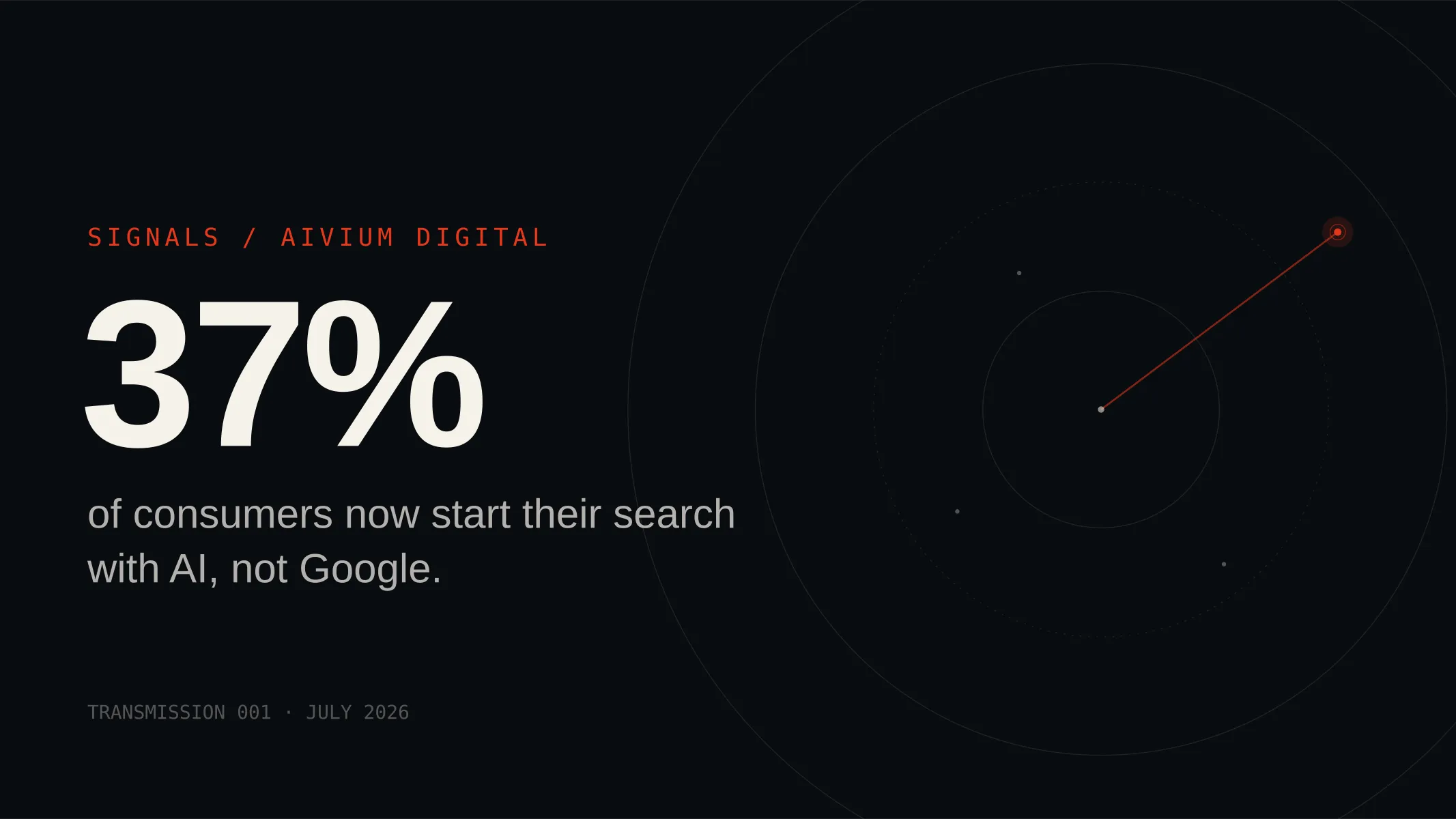
As of mid-2026, roughly 37% of consumers start their search with an AI tool instead of Google, and 30% of U.S. consumers have used AI to inform a real purchase decision. AI search is no longer a preview of how buying will work someday. For a growing share of your customers, it is how buying works now.
The numbers below are from published 2026 research. Every one of them is sourced, because that is exactly what AI engines reward and what we tell clients to publish: verifiable claims, not vibes.
The shift, in four stats
- AI-driven search grew from under 10% of search interactions in 2023 to about 30% in 2026.
- 37% of consumers now start searches with AI tools instead of a search engine, and ChatGPT alone has passed 900 million weekly users, up from 400 million in early 2025.
- ChatGPT carries about 60.7% of all AI search traffic as of February 2026.
- 58% of shoppers say they use generative AI instead of traditional search to find recommendations.
None of this means Google is gone. About 95% of Americans still use traditional search monthly. Your buyers did not move. They added a second front door, and the second door answers with three names instead of ten links.
Who is actually deciding with AI
Capital One Shopping’s 2026 research puts AI-informed purchasing at 30% of all U.S. consumers, and the generational split shows where this is heading:
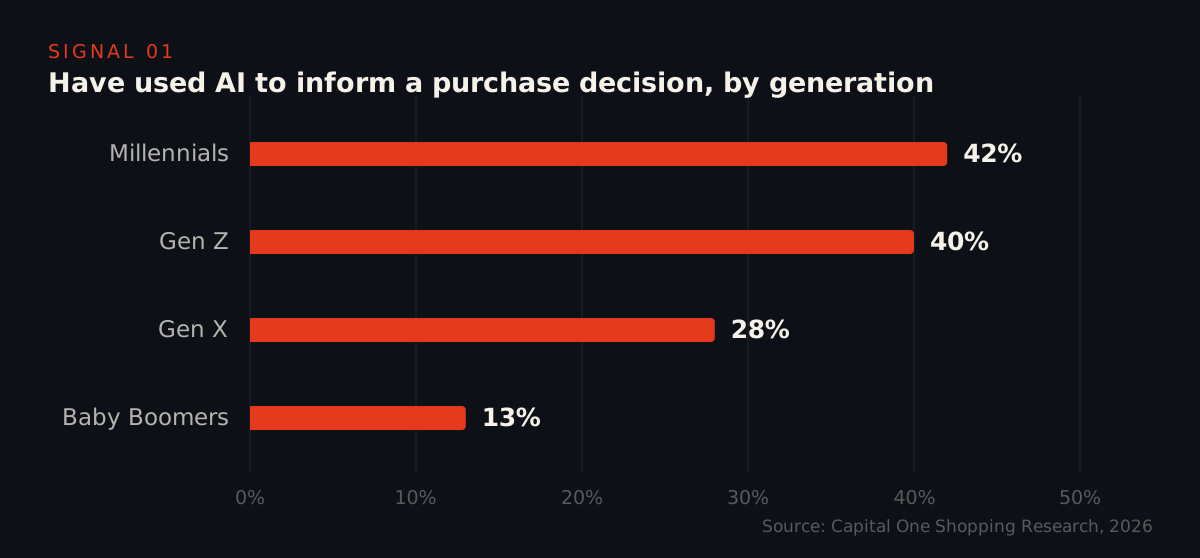
Millennials and Gen Z are your next decade of customers, and two in five of them already let AI shape what they buy. The categories lead with considered purchases: 71% use AI for travel research, 65% for electronics, and 62% for financial products. Exactly the kind of decisions where being one of the names the AI mentions is worth real money.
One more finding that should shape your strategy, from Gartner’s May 2026 consumer survey: among consumers who used AI for product research in the past 90 days, 86% verified the AI’s recommendation somewhere else before buying.
The AI answer is not the end of the journey. It is the new shortlist. Buyers ask AI who to consider, then go confirm. If you are not in the answer, you are not in the running. If you are in the answer but your site, reviews, and profiles cannot survive the verification step, you lose the sale anyway.
What happens to clicks when AI answers
The same shift shows up inside Google itself. Pew Research Center found that when an AI Overview appears, users click any result on only 8% of visits, versus 15% when it does not:
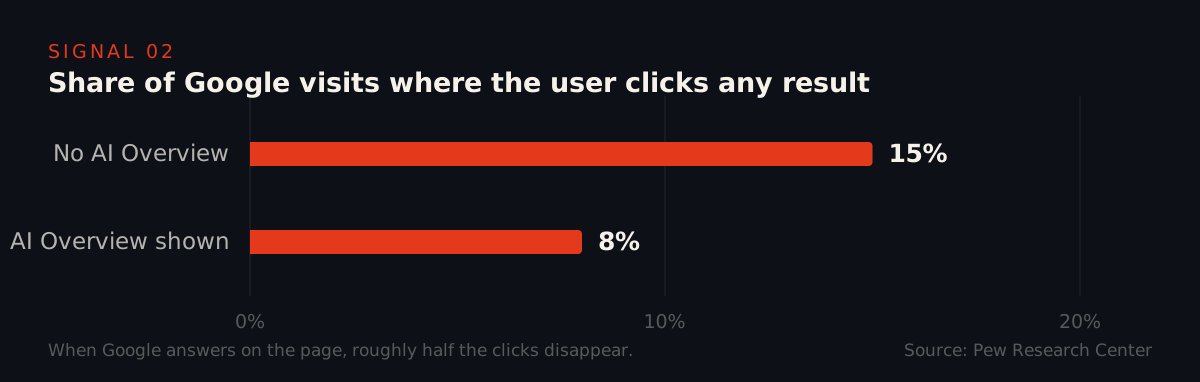
Ahrefs measured a 58% drop in click-through for the top organic result when an AI Overview is present. The clicks that survive are not spread evenly: AI Overviews redistribute traffic toward the sites they cite and away from everyone else. And engagement with the AI answers themselves is climbing: Seer Interactive measured CTR on AI Overviews nearly doubling between December 2025 and February 2026.
The July 2026 scoreboard
| Signal | Number | Source |
|---|---|---|
| Consumers starting searches with AI | 37% | Stackmatix, 2026 |
| U.S. consumers using AI to inform purchases | 30% | Capital One Shopping, 2026 |
| Millennials using AI for purchase decisions | 42% | Capital One Shopping, 2026 |
| Shoppers using GenAI instead of search for recommendations | 58% | Bloomreach, 2026 |
| AI researchers who verify before buying | 86% | Gartner, May 2026 |
| Click rate on Google visits with an AI Overview | 8% vs 15% | Pew Research Center |
| CTR drop for the #1 result under an AI Overview | 58% | Ahrefs, Dec 2025 |
What this means if you run a business
Three practical conclusions fall out of the data:
- Being findable is no longer the same as being ranked. An AI answer names a handful of businesses. Generative engine optimization is the work of becoming one of them, and it runs on different inputs than classic SEO: entity consistency, liftable answers, and the third-party sources each engine trusts.
- The verification layer decides the sale. With 86% of AI-assisted buyers double-checking, your reviews, profiles, and site have to agree with what the AI said about you. Contradictions kill conversions.
- The window is a first-mover window. Most of your competitors, from local operators to mid-market brands, have not done this work. The seats in the answer are limited, and early entities tend to keep getting cited.
This is the exact problem our GEO service exists to solve: we audit what the six major engines say when your buyers ask, engineer your entity and sources, and track your share of the answer monthly. If you want to know where you stand today, book a free discovery call and we will show you the answers your customers are already seeing.
Questions, answered.
What percentage of people use AI search in 2026?
About 37% of consumers now start searches with an AI tool instead of a search engine, and AI-driven search accounts for roughly 30% of all search interactions in 2026, up from under 10% in 2023. Most people use AI alongside Google rather than replacing it.
Do people trust AI recommendations when making purchases?
Cautiously. Gartner's May 2026 survey found that 86% of consumers who used AI for product research verified the recommendation somewhere else before buying. The AI answer works as a shortlist; your reviews, profiles, and website then close or lose the sale.
How do Google AI Overviews affect website clicks?
When Google shows an AI Overview, users click a result on only about 8% of visits versus 15% without one, and the top organic result loses roughly 58% of its click-through rate. The clicks that remain concentrate on the sites the AI Overview cites.